Repair or Replace? How to Actually Make the Call on Your Roof
The honest way to decide between one more patch and a full re-roof, based on what the roof is actually telling you.
September 3, 2026 · 3 min read
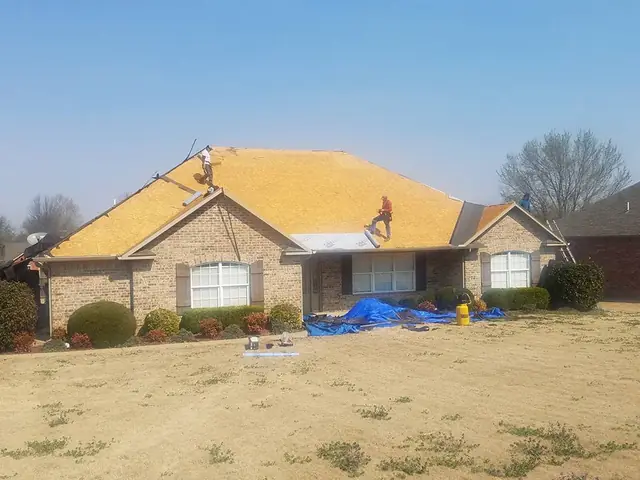
The honest starting point: how many storms has this roof taken
Every roof has a repair-or-replace point, and the fastest way to find it is to count backward. If this is the first real storm the roof has seen since it went on, an isolated repair usually makes sense. If you're now looking at the third or fourth patch job after the third or fourth storm, the math starts to shift, because you're not paying for one repair anymore. You're paying for a slow-motion replacement spread out over several years and several invoices.
What the decking tells you, even before tear-off
You can't see the decking from the ground, but it leaves clues. A roofline that looks slightly wavy instead of straight from the street is one. A stain on a ceiling directly under a valley is another, and it usually means water has been finding its way past the shingles for longer than anyone noticed. Neither one proves the decking is bad, but both are reasons to get someone up there before deciding a simple patch will hold.
- A wavy or uneven ridge line viewed from the street
- Ceiling stains that line up with a roof valley or a chimney
- A soft or spongy feel anywhere a roofer walks the slope
- Daylight visible through the attic decking, which means the problem is already serious
Ridge and valley wear: the first places to fail
Ridge caps take wind from both sides of the roof, so they wear out faster than the field shingles around them. Valleys carry more water than any other part of the roof by a wide margin. When either one starts showing granule loss or cracking while the rest of the roof still looks reasonable, that's often a sign the roof is aging out even if it doesn't look old anywhere else.
The patch-history math
One patch after one storm is just maintenance. But every patch is also a new seam, and every seam is a new place water can eventually find a way in. A roof carrying several patches from several different storms over the years is carrying more risk with each one, and at some point the cost of the next likely repair, plus the one after that, adds up to more than doing the full re-roof once and starting the clock over.
Commercial roofs run the same calculation, at a different scale
A commercial low-slope roof doesn't fail the way a steep residential roof does, but the underlying question is identical: is the damage isolated to something a patch fixes, or is it a sign the whole system is reaching the end of what a patch can realistically hold together. On a bigger roof, guessing wrong in either direction costs more, which is exactly why it's worth getting an actual inspection rather than deciding from the parking lot.
What a real inspection looks like versus a guess
A roofer walking the actual slopes, checking the decking by feel in a few spots, and looking closely at the ridge and valley lines gives you something a drive-by estimate never can: an actual answer instead of a probability. On our team, David is usually the one out assessing damage and walking homeowners through exactly what he found, and that inspection is treated as the first real step, not a formality on the way to recommending the most expensive option.
When repair is genuinely the right call
None of this means replacement is always the answer. A roof that's still young, with sound decking and damage confined to one slope or one clearly identifiable spot, is a good candidate for a straight repair, and there's no reason to pay for more work than the roof actually needs. Grand Roofing Company handles both repairs and full re-roofs, residential and commercial, so the recommendation isn't coming from someone who only gets paid if you replace the whole thing.
If you want an honest look at where your roof actually stands, call (405) 334-9475. Someone will come out, look at the decking condition, the ridge and valley wear, and the storm history you can tell them about, and give you a straight answer instead of a sales pitch. There's no cost to finding out which side of the line your roof actually falls on before you commit to either option.
Grand Roofing Company LLC — (405) 334-9475
Call (405) 334-9475More articles
Hail Damage or Just Wear? What to Check Before You Call Anyone
A straightforward look at what hail actually does to a shingle roof, and how to document it properly before anyone climbs a ladder.
Class 3 vs Class 4 Shingles: What the Rating Actually Means for Your Insurance
The difference between Class 3 and Class 4 shingles comes down to one steel-ball test, and it can show up on your insurance bill.